
Jim Thorpe – Olympic legend and all-round sporting great
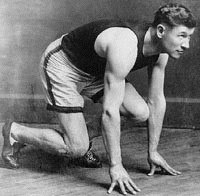 Few athletes have demonstrated the extraordinary versatility of Jim Thorpe. Born into the Sac and Fox Nation in present-day Oklahoma, he became a remarkable figure in American sporting history. His achievements crossed the boundaries of athletics, American football and baseball, establishing a legacy that extended far beyond the Olympic stadium.
Thorpe's Native American name, Wa-Tho-Huk, is commonly translated as "Bright Path". His athletic abilities emerged at the Carlisle Indian Industrial School in Pennsylvania, where he developed into an outstanding football player and track and field athlete under coach Glenn "Pop" Warner.
Olympic glory in Stockholm 1912
Thorpe achieved his greatest international success at the 1912 Olympic Games in Stockholm, winning gold medals in both the pentathlon and decathlon. His dominance was remarkable: he won four of the five pentathlon disciplines and produced an outstanding performance across the ten decathlon events.
In the decathlon, Thorpe scored 8412.955 points under the original scoring system, comfortably defeating Sweden's Hugo Wieslander. His performance established him as the leading combined events athlete of his era and became an important milestone in the historical progression of combined events world records.
Thorpe also competed in the individual high jump and long jump, finishing fourth and seventh respectively. His success in several disciplines at the same Olympic Games demonstrated an exceptional range of athletic abilities.
The Olympic medal controversy
In 1913, Thorpe's Olympic victories were taken away after officials discovered that he had previously received payment for playing minor league baseball. Under the strict amateurism regulations of the period, this was considered a violation of Olympic eligibility rules.
The decision became one of the most controversial episodes in Olympic history. Thorpe had competed openly and successfully in Stockholm, yet his achievements were removed from the official records because of activities unrelated to his Olympic performances.
Decades later, efforts to correct the injustice began to succeed. In 1982, the International Olympic Committee approved the restoration of his Olympic status, and commemorative gold medals were presented to his family in 1983. However, he was initially recognised only as a co-champion.
Full recognition after 110 years
On 15 July 2022, exactly 110 years after his decathlon victory, the International Olympic Committee announced that Thorpe would be recognised as the sole gold medallist in both the pentathlon and decathlon at Stockholm 1912.
The decision finally restored his position as the undisputed Olympic champion in both events. It also corrected the historical record, recognising the achievements that had made him an international sporting legend.
Thorpe's name now stands alone among the champions of the earliest Olympic decathlons. His achievement can also be explored in the Decathlon 2000 Olympic decathlon records, champions and medal table.
A remarkable career beyond athletics
Thorpe's sporting achievements were not limited to track and field. He became a major star in American football, representing teams including the Canton Bulldogs and later playing in the early years of professional football's development.
He also played Major League Baseball between 1913 and 1919, appearing for the New York Giants, Cincinnati Reds and Boston Braves. His ability to compete professionally in different sports made him one of the most versatile athletes of the early twentieth century.
Thorpe served as the first president of the American Professional Football Association, established in 1920 and later renamed the National Football League (NFL). His influence on American football continued long after his playing career ended.
Career highlights
| Jim Thorpe – career overview | |
| Full name | James Francis Thorpe |
| Born | 28 May 1887 or 1888, Indian Territory (present-day Oklahoma, USA) |
| Died | 28 March 1953 |
| Nationality | United States |
| Olympic Games | Stockholm 1912 |
| Olympic gold medals | Decathlon and pentathlon |
| Other Olympic results | High jump – 4th; long jump – 7th |
| Other sports | American football, baseball and basketball |
| Major recognition | Associated Press Greatest Male Athlete of the First Half of the 20th Century (1950) |
| Olympic titles restored | 1982–1983; sole champion status confirmed in 2022 |
Did you know?
Thorpe's Olympic success was particularly extraordinary because he had relatively little experience in some of the decathlon disciplines. According to USA Track & Field, he had never previously competed in a decathlon and had only begun learning the javelin throw shortly before the Stockholm Games.
Another remarkable detail concerns his rival Hugo Wieslander. Although the Swedish athlete was officially awarded Thorpe's decathlon gold medal following the 1913 disqualification, Wieslander never accepted the title as rightfully his. His family's support later helped make Thorpe's full recognition possible in 2022.
A lasting sporting legacy
Jim Thorpe died in 1953, but his achievements remain an important part of Olympic and sporting history. His career demonstrated that exceptional athletic ability could extend across very different disciplines, while the long struggle to restore his Olympic titles revealed how sporting regulations and attitudes have changed over time.
More than a century after Stockholm 1912, Thorpe remains one of the defining figures in the history of the decathlon and a lasting symbol of all-round athletic excellence.